
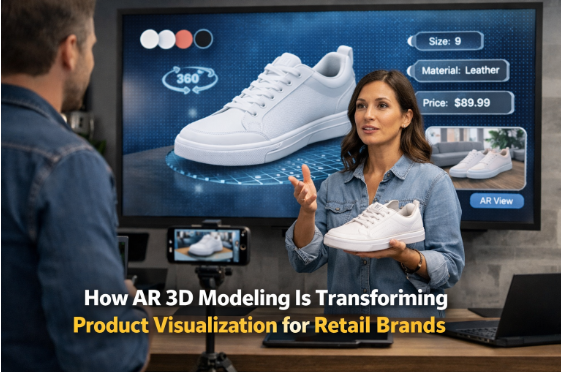


The retail brands face a more digital-first world that is experiencing a growing expectation by customers. Customers are not satisfied with lifeless images and brief product descriptions; they require seeing, touching, and knowing more about the products prior to buying them. Such a change in consumer behavior has made AR 3D modeling an important weapon that is reimagining the way products are displayed and consumed in the retail markets.
With augmented reality and enhanced product modeling technologies, retail brand experience is producing a product visualization that closes the divide between online shopping and in-store shopping. With the assistance of professional 3D modelling services, AR-based images are assisting brands in enhancing interaction, increasing confidence, and converting more.
Making Products More Like Real-Life Experiences
Another major constraint of conventional retail visualization is that it is impossible to simulate real-world interactions. No depth, scale, or context is given to flat images. AR 3D modeling solves this dilemma because customers can see products in their respective settings using smartphones, tablets, or AR-enabling gadgets.
Retail brands can now offer:
- Real-life size product placements.
- True to life textures and finishes.
- Interactive 360-degree viewing
- Contextual previews on physical spaces.
Such realistic viewing contributes greatly to the shopping experience and minimizes the element of indecision in the decision-making process.
Building Buyer Confidence and Minimizing Purchase Hesitation
The tendency to purchase hesitation is a typical aspect of online shopping, particularly for products with high value or size sensitivity. When a customer is able to see how an item would fit in his or her lifestyle, confidence grows.
Using AR 3D modeling, the shopper can:
- Visit the way that furniture fits in their room.
- Wearables Preview on Wearables.
- See how the appliances fit into their location.
- Competently comprehend product proportions.
The retail brands that utilize high-quality 3D modeling services report high customer satisfaction and reduced abandoned carts as a result of uncertainty.
Reducing Product Returns and Associated Costs
The cost driver of retail, especially e-commerce, is returns. Many returns occur due to products failing to match the expectations of the customers during delivery.
Brands ensure that customers make informed decisions by giving them correct interactive previews with an AR 3D model. This clarity leads to:
- The expectations are less incompatible.
- Reduced return rates
- Reduce reverse logistics expenses.
- Better operational efficiency.
Enhanced visualization before purchase is directly proportional to cost savings in the long term.
Increasing Customer Interaction at the Digital Touchpoints
One of the most important measures of the success of retail is customer engagement. The interactive AR experiences inherently make people spend longer periods of time looking at the product and exploring it in a more in-depth way.
AR applications based on 3D modeling services used by retail brands tend to encounter:
- Increased product page time.
- Better rates of interaction.
- Greater product emotional attachment.
- Improved brand recall
Such points of engagement not only affect the purchase decisions but also enhance brand loyalty.
Supporting Omnichannel Retail Strategies
Contemporary retail is not restricted to one platform anymore. Brands can exist on the web, mobile crisis, social media, and online stores. AR 3D modeling brings unity in all these channels.
3D assets can be reused for:
- E-commerce listings
- Mobile shopping apps
- In-store digital displays
- Social media campaigns
- Virtual showrooms
Through scalable 3D models services, brands are able to be consistent and create less content creation.
Accelerated Product Release and Graphical Review
Conventional product photography uses physical samples, studio lighting, and has to be reshooted in each variation. AR-based 3D models will remove most of these constraints.
Retail brands benefit from:
- Quick visualization of products to be manufactured.
- Convenient color or configuration changes.
- Less reliance on reshoots.
- Faster go-to-market cycles.
This flexibility comes in particularly handy in retail sectors that are very fast-paced and where speed is of the essence.
Enhancing Competitive Markets Brand Differentiation
The retail market is full of retail stores, and there are numerous brands dealing in the same products. Graphical distinction is significant in conspicuousness. AR 3D modeling enables the brands to display the products in a more innovative and high-end manner.
Engaging experiences represent a sign of technological innovation and focus on the customer, assisting brands in gaining a better market position.
Future Proof Retail Experiences
With the ongoing development of immersive technologies, visualization based on AR is becoming the cornerstone of retail innovation in the future. Brands that have already invested in AR 3D modeling are in a better position to utilize the new technologies emerging, like virtual stores, metaverse commerce, and AI-based personalization.
The retail brands are able to scale these experiences with flexible 3D modeling solutions without having to recreate assets.
Conclusion
AR 3D modeling is at the centre of product visualization, aiming to satisfy the requirements of the current shopper, and retail brands are redefining it. AR-driven experiences provide quantifiable business value by providing realistic previews, higher buyer confidence, lower returns, and an increased level of engagement.
With the help of professional 3D modeling solutions, the retail brands will have the means to create immersive, scalable, and future-proof shopping experiences that appeal to the current digital consumers.